Lamp III · Live Checked
Xingtu 星图
A rendering engine for points, straight lines and groups, with two maps running on it.
- Room
- A reader of Chinese living in Germany
- Made of
- One engine.js for points, straight lines and groups; one configuration file per map; Python scripts that build the data
- Made for
- A personal project, built 20 to 27 August 2026
- State
- Live on GitHub Pages; last change 27 August 2026. Interface in Chinese.
- Made by
- Hongyu Zhou, solo
- Credit
- The constellation illustrations on the live site are by Johan Meuris, drawn for Stellarium, under the Free Art License 1.3, and are shipped as separately credited files. They are not shown on this page.
- Entry checked
What it does
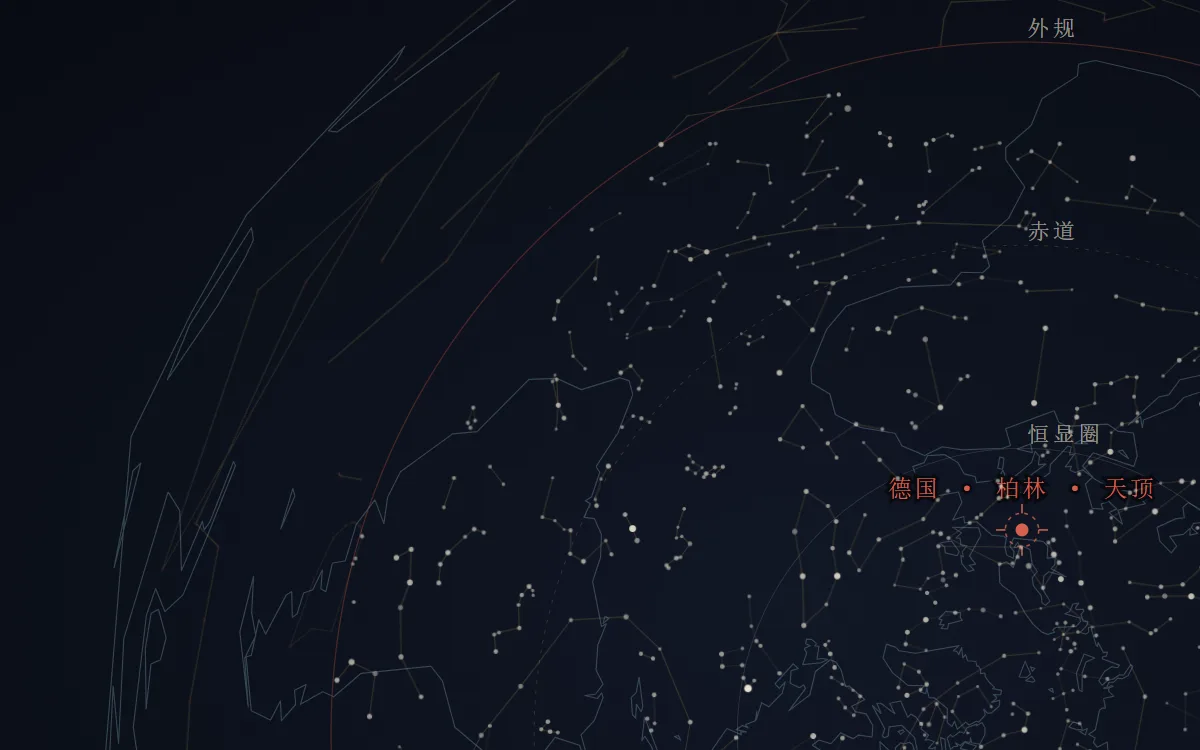
The star map draws one sky in two traditions: 308 Chinese asterisms and the 88 Western constellations. Of the 745 stars the Western lines use, 608 (82%) also appear in Chinese asterisms, so switching between the two leaves most points where they are and changes how they are joined.
The concept map splits “artificial intelligence” into 161 keywords and groups the same keywords two ways.
Everything that differs between the two maps lives in their configuration files. The engine does no layout of its own: it knows only that a point has a position. The star map’s positions come from a projection, the concept map’s from a polar layout.
Assembly drawing
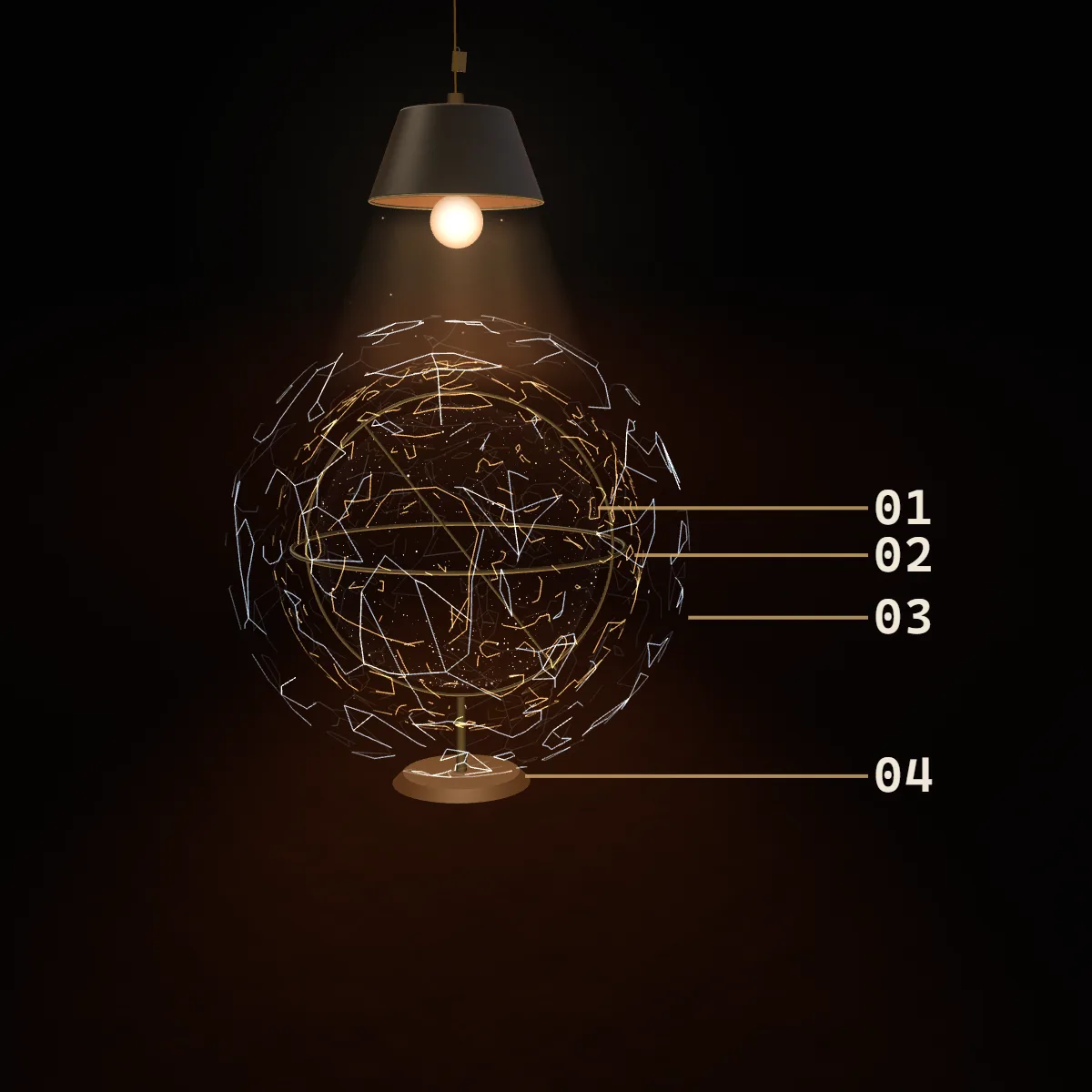
- 01 The 1,550 stars of Xingtu’s star map, at their J2000 positions
- 02 The 308 Chinese asterisms
- 03 The 88 Western constellations
- 04 One engine.js under both: points, straight lines and groups
A drawing of how Xingtu is put together, made for this site. It is not a screenshot. The globe is drawn for this site from Xingtu’s star data. Star positions: NADC, CC BY 4.0. Lines: Stellarium sky cultures, CC BY-SA 4.0.
Assembly list
Installed
- Star map: 308 Chinese asterisms and the 88 Western constellations
- Concept map: “artificial intelligence” in 161 keywords, grouped two ways
- Straight segments only: no curves, no figures
Not installed yet
- An English interface
Where to poke holes
- Positions are meant to be real: anyone who knows the sky can check whether an asterism is drawn right.
- Both groupings of the 161 keywords are data, built by scripts/build_concept.py.
Backstage
Lines are straight segments only, with no curves and no figures. Only the brightest 240 stars twinkle, and a second-magnitude star at the bottom of its twinkle keeps a contrast of 3.83:1. Where the project has no historical source, for example the size and placement of star-name labels, its notes record the choice as a design decision, not as a reconstruction.